Back to School: A Summer-Long Strategy
The back-to-school shopping season has officially outgrown its calendar. Forget the frantic August weekend runs through crowded aisles as today's savviest families are starting earlier and turning the entire summer into a strategic shopping window.
Afterpay's first-party shopping data reveals a striking behavioral shift already underway with consumers buying earlier, buying smarter, and spreading their spending across the summer months rather than cramming it into a single stressful sprint.
What the Data Is Telling Us
Analyzing Afterpay transaction data, from June 1 through July 23, 2026 compared to the same period in 2025, back-to-school related purchases are surging before most kids are even done with school or have gotten their supply lists. From calculators to school uniforms, shoppers across every generation are getting ahead of the curve.
According to PWC, with parents expecting to spend an average of $922 per household on back-to-school this year, and nearly half (47%) anticipating spending more than last year, the motivation to spread those costs out is crystal clear.
Why Families Are Shopping Earlier
This isn't just about avoiding sold-out items or beating the crowds – it's about financial strategy, especially when parents spend all-year round on activities.
Specifically, summer is expensive, with camps, travel sports, family vacations, and spontaneous activities all competing for the same household budget that back-to-school shopping needs. Spreading school purchases across June, July, and August rather than dropping $900+ in a single August weekend is how modern families are managing the financial pressure of a packed summer calendar.
The data reflects a generation of consumers who've gotten smarter about budgeting and they're not waiting to do everything during a single shopping trip. Instead they're incrementally building a back-to-school cart and timing it with peak sales or their paychecks.
The Back-to-School Category Breakdown
Calculators: One Thing That’s Always On The List
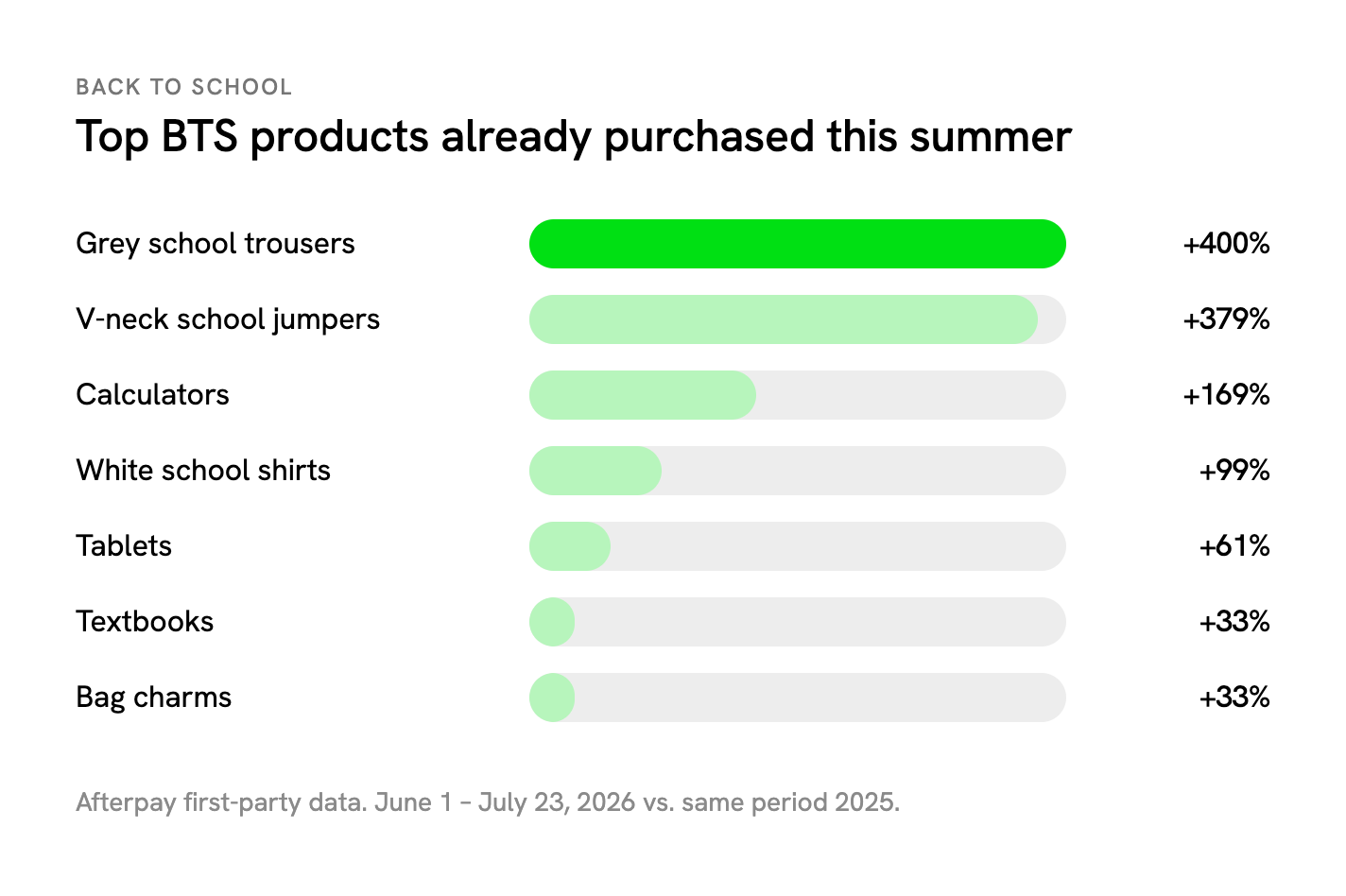
The biggest surprise in this year's early data? Calculators surged 169% year-over-year, making them one of the fastest-growing back-to-school products this summer. But here's the generational twist that makes this data truly fascinating: it's not Gen Z leading the charge, it's everyone else.
Baby Boomers are driving calculator purchases at a staggering 207% growth, followed closely by Millennials at 189%. Whether it's parents stocking up early for their kids or grandparents gifting ahead of the school year, the calculator comeback is very much a multi-generational effort.
Tablets: The Tech Investment Families Are Making Early
With tablets representing one of the more expensive line items on any school supply list, it makes sense that families are getting ahead of this purchase. Tablet purchases climbed 61% year-over-year during the early summer window and older generations are leading the early-buy behavior.
Gen X shoppers saw an 85% increase in tablet purchases, with Baby Boomers close behind at 70%. These are the parents and grandparents who've learned the hard way that waiting until August means paying full price (and dealing with out-of-stock alerts).
Textbooks: The Analog Comeback
While digital learning tools dominate headlines, textbooks are up 33% year-over-year, driven primarily by Gen X (41%) and Millennial (40%) purchasers. Whether it's parents who prefer physical books for their kids or students choosing tactile learning materials, the textbook trend suggests that not everything is going digital.
Uniform Season: Where Self-Expressions Meets Structure
For many students, uniforms represent one of the few areas where they can inject personality into an otherwise structured environment, and the data shows families are taking that seriously well before the school year begins.
Grey school trousers exploded with 400% overall growth, with Gen Z shoppers leading at 591% and Gen X at 523%. V-neck school jumpers posted an even more remarkable 379% growth as Gen Z drove an extraordinary 1,447% increase. White school shirts rounded out the uniform surge with 99% year-over-year growth, led by Gen X at 211% and Baby Boomers at 144%.
While standard uniform attire has grown, so have accessories. Over the summer, bag charms are seeing a 33% growth, led by Gen X (73%) and Baby Boomers (62%) – likely parents and grandparents who understand that when everything else has to match the dress code, a small personal touch can make all the difference. The pattern reinforces experienced parents and grandparents who know that waiting equals scrambling, but it also reveals how families are helping kids navigate the balance between compliance and individuality.
"Fashion psychology acknowledges that our teenage years are the first time we think about how we want to clothe our body and have some kind of autonomy over the choices we make. As a result, we hop from group to group until one sticks, and our social identity is then stabilized through clothing. Pre-social media, this influence would be limited to mainstream media and our immediate social circles," said Shakaila Forbes-Bell, Afterpay and Cash App Consumer Insights Psychologist
"Now, with social media, teenagers have a greater sphere of influence, and so that stabilization process takes longer than usual as the number of style identities to explore increases. As a result, parents may find themselves spending more time and money guiding their children through this period of exploration.”
Shakaila Forbes-Bell, Afterpay and Cash App Consumer Insights Psychologist
Navigating Rising Costs
With nearly half of families expecting to spend more this year than last, the financial weight of the back-to-school season is real.
"The families who feel the least stressed about back-to-school are the ones who spread these expenses out across the summer. On top of that, it helps involve your kids in the process, teaching them the importance of budgeting and planning."
Lindsay Bryan-Podvin, Financial Therapist
That's where tools like Cash App Savings come into play: families can set up a dedicated savings balance for back-to-school expenses when summer starts, meaning the money is there and earmarked before the August or September crunch hits. And for parents looking to manage money as a family and encourage healthy money habits early, Cash App Families¹ offers dedicated accounts that grow with kids and teens, turning back-to-school shopping into teachable moments around budgeting and spending smarter.
Afterpay's flexible payment options layer naturally into this strategy too, by letting families spread the cost of bigger-ticket items such as tablets, footwear, and tech across multiple payments rather than absorbing a single large hit to the household budget.
The Bottom Line
The data says back-to-school shopping is a summer-long event, and the families who treat it that way are the ones who'll feel the least financial stress when the school season arrives.
The early-bird strategy is winning, whether you're a Gen X parent stocking up on uniform trousers in July or a Gen Z student snagging the right twin XL bed sheets before they sell out.
Start your back-to-school shopping list now, set up a savings goal in Cash App, and let Afterpay help you spread the bigger purchases across the summer.²
Afterpay data analyzed between June 1 - July 23, 2026 vs. same period in 2025
Cash App is a financial services platform, not a bank. Banking services provided by Cash App's bank partner(s). Savings provided by Cash App, a Block Inc. brand
- Parents and legal guardians can open a managed account for kids 6-12. Teens 13 to 17 can use Cash App with sponsorship by an eligible parent or guardian.To view the eligibility requirements for sponsoring a teen or child, please visit the Sponsored Accounts section of the Cash App Terms of Service"
- Afterpay is offered and managed through your Cash App account - no Afterpay account needed. Eligibility is based on several factors and is not guaranteed. Afterpay is not available in all states. Afterpay loans issued by First Electronic Bank, serviced by Square Capital, Inc. View state licenses