THE GIST OF IT
- Most allowance plans fail because parents forget to pay on time, not because the amount was wrong.
- Automating the transfer removes you from the process and teaches kids that money arrives predictably.
- A simple spend/save/give split builds habits without overcomplicating things for younger kids.
- Whether you tie allowance to chores or keep them separate matters less than staying consistent with whichever you choose.
How to set up an allowance that doesn't fizzle out
According to Cash App's 2024 Raising Gen Alpha study, 93% of parents of Gen Alpha kids say their children receive their own money, most commonly through an allowance or gifts (62% each). The money itself isn't the hard part. The hard part is the third week, when you forget to hit the ATM and your kid's "financial education" quietly dies on the vine.
Most allowance plans die from inconsistency, not from choosing the wrong dollar amount. When the transfer skips a week (or two), your kid absorbs a different lesson entirely: that money shows up when someone remembers, not when they plan for it.
The fix is simpler than most parents expect: take yourself out of the delivery chain.
Pick a schedule before you pick a number
Parents tend to start with the dollar amount — how much is right for a 9-year-old? — and then figure out logistics later. Flip that order. A predictable schedule matters more than the perfect number, because what you're actually teaching is reliability.
Weekly works well for younger kids who haven't developed a long time horizon. Biweekly or monthly can work for teens who are already managing other deadlines. The Consumer Financial Protection Bureau's Money as You Grow resource organizes financial milestones by age band, which is a useful frame: younger kids operate in shorter time horizons, while teens can plan further out.
Pick one schedule and commit. You can always adjust the amount, but switching from weekly to biweekly mid-stream creates exactly the kind of confusion you're trying to avoid.
Automate the transfer so you're out of the loop
Cash allowances depend on you remembering, and you've already got 30 things competing for your attention on any given Tuesday. The week you forget (and there will be one), your kid doesn't learn about budgeting. They learn that the allowance isn't something they can count on.
Automating the transfer eliminates the nagging loop. Your kid gets the money on the same day, every time. You stop fielding "did you remember?" questions. And the allowance becomes what it's supposed to be: a tool for practicing decisions, not a reminder of who forgot what.
Most banking apps and payment platforms let you set up recurring transfers. The tool matters less than the automation. Set it once, confirm it works, and move on.
Tell your kid what the money is for (and what it isn't)
A deposit without context is just spending money. Before the first transfer hits, have one short conversation: what does this allowance cover, and what doesn't it cover?
For younger kids, this might be simple: "This is yours. You can save it or spend it on things you want — but I'm still buying your school supplies." For teens, the scope can expand: "This covers your lunch money and entertainment. If you run out, you wait until next week."
That single boundary (what's covered, what's not) is what turns a weekly deposit into actual practice at making trade-offs.
How much allowance should you give by age?
Parents usually want a number first. A recent Wells Fargo study found that kids ages 5 to 17 get about $37 a week on average, though the older rule of thumb runs lower: about $1 per week for each year of age, so $8 for an 8-year-old and $14 for a 14-year-old. Any of these works as a starting point.
But the amount isn't what teaches your kid about money. Regular payments do. Cash App's Raising Gen Alpha study found that 77% of parents already talk to their kids about money, so most families have the intent. Where it breaks down is paying on a schedule the kid can count on. A smaller allowance that always lands on Friday does more good than a bigger one that shows up whenever you remember. Pick an amount you can keep up with, and pay it on time.
A quick reference by age group
- Ages 6–9: $5–$10 per week. Keep it small and tangible. At this stage, handling physical coins and bills still teaches something useful, but digital deposits can start supplementing.
- Ages 10–12: $10–$15 per week. 89% of Gen Alpha kids are already saving for something. Give them enough to make real trade-offs between spending now and saving for a goal.
- Ages 13–15: $15–$25 per week. This is when peer spending enters the picture — movie tickets, group meals, small purchases with friends. The allowance should cover some of this so they practice saying "I can't afford that this week."
- Ages 16–17: $20–$35 per week (or shift to monthly). Many teens at this age have some income of their own. The allowance can narrow to cover specific categories while they manage earned money separately.
When to raise the amount
Raise it when responsibilities increase, not as a reward for good behavior. Starting middle school, getting a phone plan, or taking on a new extracurricular with costs are natural inflection points. According to the same 2024 Cash App research, parents taught about money before age 13 are nearly twice as likely to teach their own kids before 13 (62% vs. 34%) — so early conversations about raises are part of the pattern.
Annual birthday bumps work, too. They're predictable, easy to remember, and give you a natural moment to revisit what the allowance covers.
Should allowance be tied to chores?
This is the question that stalls more allowance plans than any dollar amount ever has. And the honest answer is: both approaches are defensible. Consistency matters more than which one you pick.
The case for tying allowance to chores
It’s common for parents to offer kids an allowance for doing chores. The logic is straightforward: money is earned, not given, and chores create an early connection between work and pay. For some families, this is the structure that makes the whole system make sense.
The risk is execution. When allowance depends on a chore chart, you need to track completion, which adds a management layer. If you miss a week of tracking, the system breaks down. You're back to inconsistency.
The case for keeping them separate
Some parents might give a general allowance with no chore requirement. The thinking: chores are household responsibilities everyone shares, and allowance is a tool for learning money management. Keeping them separate means neither one depends on the other to function.
This approach is simpler to maintain, which is its biggest advantage for busy families. No tracking, no disputes about whether the dishwasher was loaded "well enough."
A middle path that works for busy families
Some families split the difference: a base allowance that's unconditional and automated, plus bonus pay for tasks that go beyond normal household expectations. Washing the car or organizing the garage earns extra, but the core amount stays untouched whether or not the bonus tasks get done.
Arguments drop because the base isn't at stake. And you keep the zero-maintenance delivery that makes the whole system sustainable.
Teaching kids to manage their allowance (not just receive it)
Depositing money into a kid's account takes 30 seconds. The harder question, and the more valuable one, is what happens after it lands.
The spend/save/give split
A common framework divides each allowance payment into three buckets: spending, saving, and giving. The ratio matters less than the habit. Even a 70/20/10 split, where most of the money is spendable, teaches the principle that not every dollar is for right now.
Physical jars or envelopes make the concept concrete for kids under 10. Once they're older, separate digital balances serve the same purpose without cluttering the kitchen counter.
Cash App lets you create multiple savings goals, which makes the three-bucket strategy dead simple to manage. Your Cash balance becomes the spending bucket. Each savings goal you create is a separate save bucket, labeled for whatever your kid is actually working toward: a new game, a bike, concert tickets. And you can set up another goal specifically for giving. Instead of one generic savings pile, your kid sees exactly how close they are to each thing they want. That turns "I'm saving money" into "I'm $23 away from that skateboard." That clarity is what keeps them from raiding the savings bucket when they're bored on a Tuesday.
Increasing responsibility with age
As kids get older, expand what the allowance covers and let them manage more categories. A 10-year-old might just handle "fun money." A 15-year-old could be responsible for their own clothing budget for one season to learn what things actually cost.
You're not setting them up to fail. You're letting a $12 mistake happen at age 11 so they don't make a $1,200 version at 22. A blown allowance, an empty balance, a week of waiting — that's the curriculum working.
Digital tools vs. cash: what actually works for modern families
A jar of quarters on the dresser works fine at age 7. By age 11, your kid is buying things online, splitting costs with friends, and losing cash in jacket pockets. Digital tools solve the automation problem and give kids something cash never could: a running record of where the money actually went.
What subscription-based kids' finance apps get you
Several apps designed specifically for kids bundle automatic allowance delivery with chore-tracking, savings goals, and gamified financial lessons, and they might come with subscription fees. The upside is that everything lives in one place: the chore chart, the allowance, and the teaching tools. The downside is the recurring cost and the question of whether your kid will actually use the gamified features after the first month.
These platforms tend to work well for families who want a structured curriculum alongside money management. If you're the type who wants the app to do the teaching, this is the trade-off you're paying for.
What free apps with kid/teen accounts get you
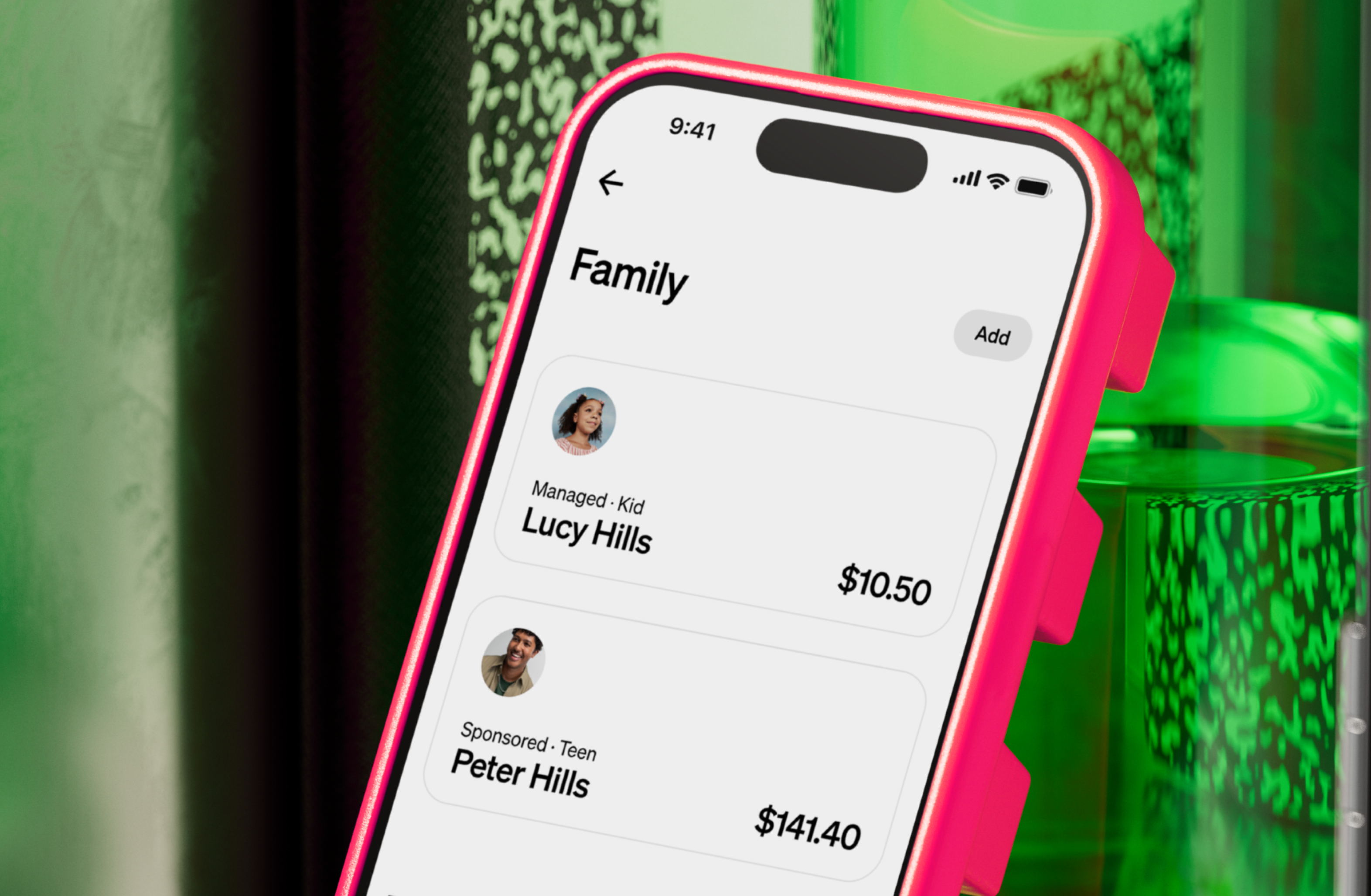
Some apps skip the monthly fee. Cash App, for example, offers managed accounts for kids ages 6–121 and sponsored accounts for teens2 that automate the allowance transfer, come with a debit card, and let both parent and kid see the balance. What they usually leave out is the chore-tracking and the built-in lessons.
So you're not paying a subscription, but the teaching is on you. If you'd rather run those money conversations yourself anyway, that suits you fine.
The bottom line: build a system that runs itself
Setting up an allowance isn't about finding the perfect system — it's about building one that runs without you having to think about it every week. Automate the transfer, set clear boundaries about what the money covers, and let your kid practice making decisions while the stakes are still small. The mistakes they make at 12 with $15 are the ones they won't repeat at 22 with $1,500.
Ready to set up an automated allowance that actually sticks? Cash App lets you schedule recurring transfers, give your kid a debit card, and monitor spending — all without a subscription fee. Download the app and get the first payment scheduled in under five minutes.